
CHRIS RICE COOPER BLOG–PhotoFeature Story : Mark Tulin’s “Ancient Pyramid”
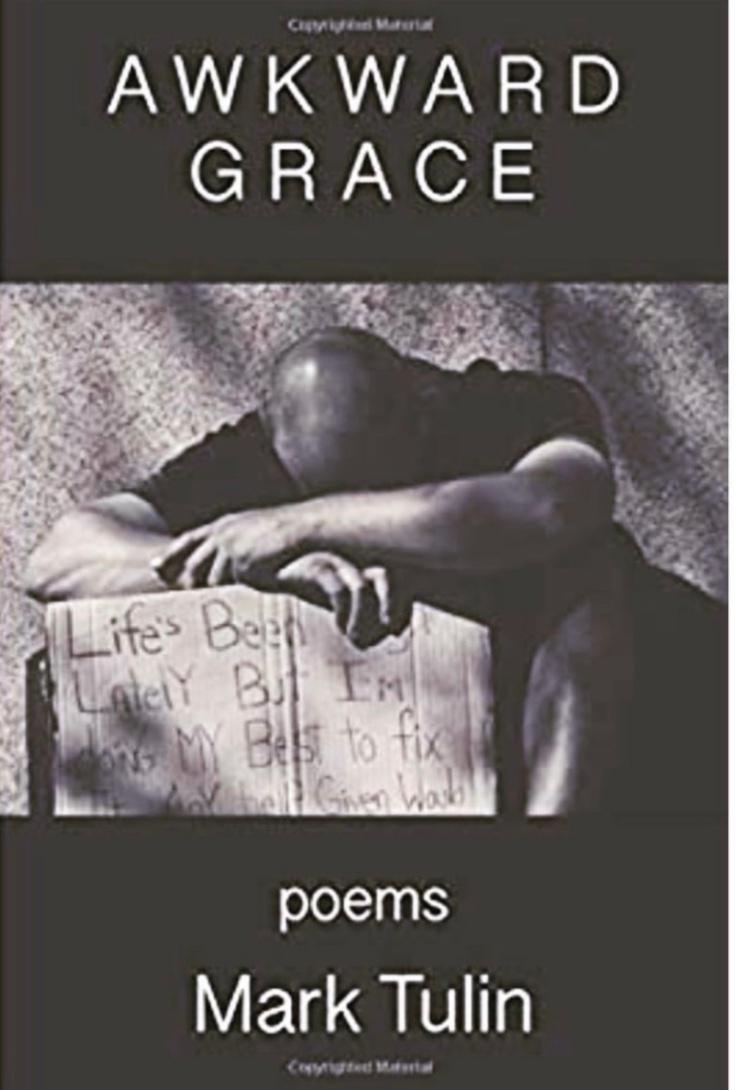
This is the story of how my poem “Ancient Pyramid” came to be. The poem is included after the interview. It is also available in my poetry book, Awkward Grace.
— chrisricecooper.blogspot.com/2020/08/mark-tulins-ancient-pyramid-is-209-in.html
Mark Tulin’s “Ancient Pyramid” is #209 in the never-ending series called BACKSTORY OF THE POEM
*The images in this specific piece are granted copyright privilege by: Public Domain, CCSAL, GNU Free Documentation Licenses, Fair Use Under The United States Copyright Law, or given copyright privilege by the copyright holder which is identified beneath the individual photo.
***Mark Tulin’s “Ancient Pyramid” is #209 in the never-ending series called BACKSTORY OF THE POEM, where the Chris Rice Cooper Blog (CRC) focuses on one specific poem and how the poet wrote that specific poem. All BACKSTORY OF THE POEM links are at the end of this piece.
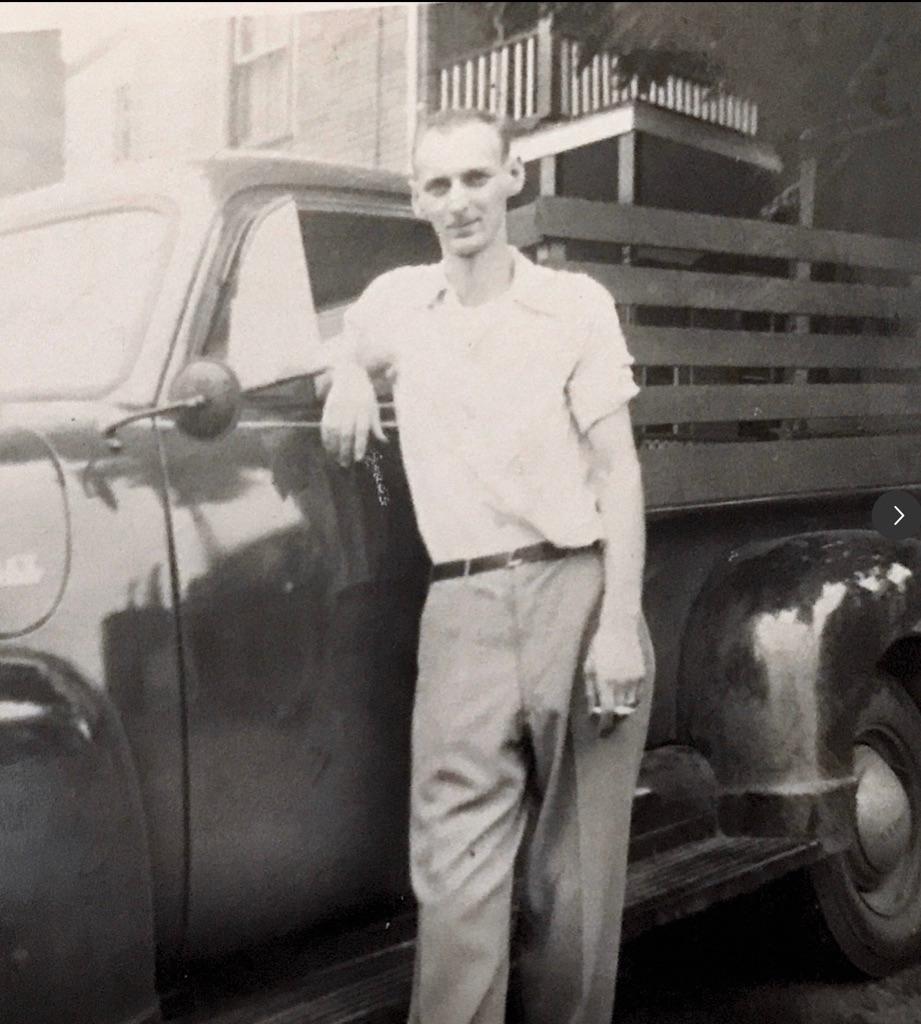
Can you go through the step-by-step process of writing this poem from the moment the idea was first conceived in your brain until its final form? The poem “Ancient Pyramid” was conceived when I was about nine or ten years old. (Below Right)

I worked for my uncle in Pottsville, Pennsylvania. He was a produce wholesaler who had rather shabby employees, derelicts as a matter of fact, although I loved them all. One such person was Stanley, who drifted in and out of homelessness and often slept in the warehouse by a space heater when he had no other place to stay. He was the source of this poem. I loved how Stanley bagged potatoes and onions and worked the electric bagging machine. It may not be exciting to many, but as a child, I was enthralled by the process.
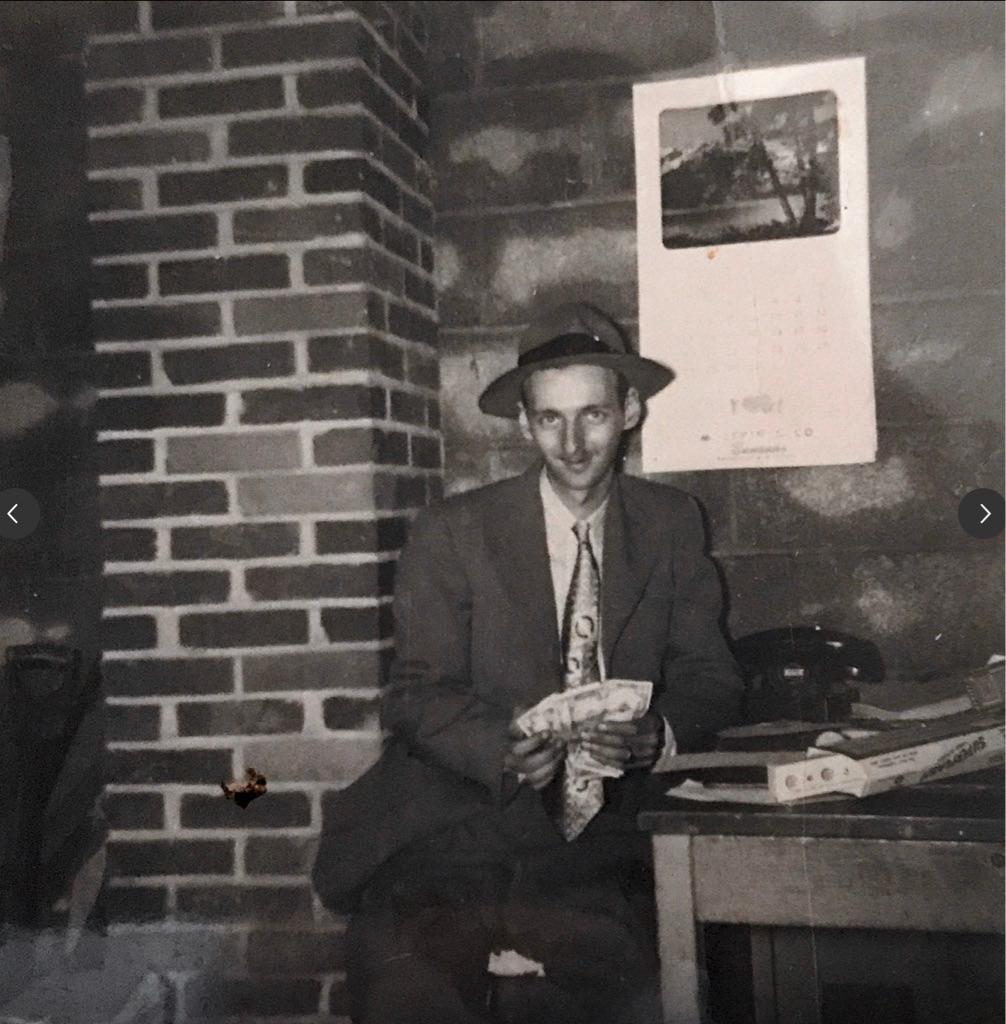
Where were you when you started to actually write the poem? And please describe the place in great detail. I began writing about my Uncle Leon (Uncle Leon LEFT and BELOW RIGHT) initially, then reminisced about his various employees, especially Stanley. Stanley kept popping into my mind, and when I decided to write about him, I wasn’t sure if it would be a short story or a poem. I start with a poem and, in this case, kept it that way. I was in Santa Barbara at the time and had recently moved there from Philadelphia. I was looking for my writing muse and took an internet course on “Truth in Writing.”
What month and year did you start writing this poem? I began writing this poem in the fall of 2015. I was in the Good Cup coffee shop on State Street, Santa Barbara. I was drinking my usual Lemon Myrtle tea. It was probably about 11 am.
During that year, I started to focus more seriously on my writing, especially poetry and memoir fiction; the people and places that I knew well, especially the quirky people who had always piqued my interest.
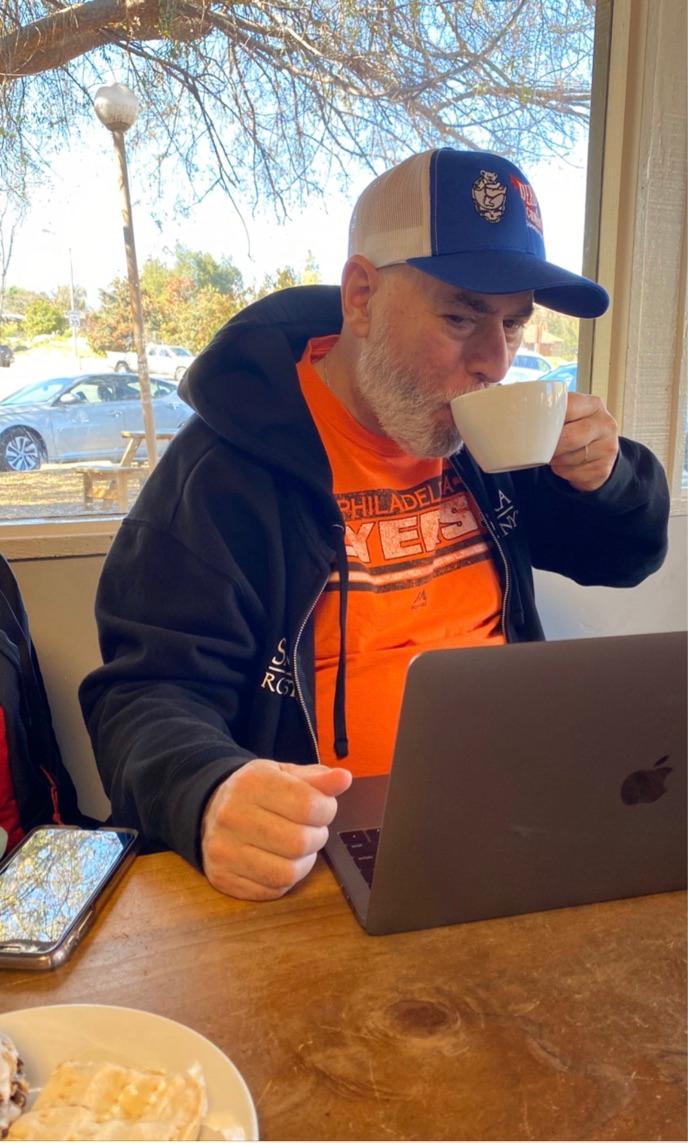
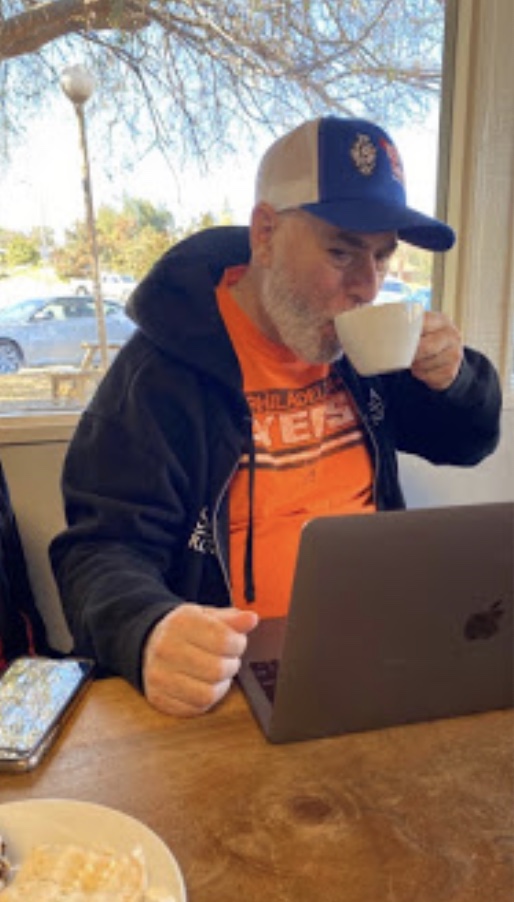
How many drafts of this poem did you write before going to the final? (And can you share a photograph of your rough drafts with pen markings on it?). I usually go through at least ten drafts of a poem over months and years in many cases. When I called the poem “Ancient Pyramid,” did the poem truly come together. Stanley had a way of stacking the potato bags. He’d place the five and ten-pound bags of potatoes on a wooden pallet and line them up so they would eventually form a pyramid about six feet high. (Left: Mark Tulin’s writing space at the local cafe)

Were there any lines in any of your rough drafts of this poem that were not in the final version? And can you share them with us? I changed one line in particular, “Stanley takes a sip of whiskey.” I changed this to “Stanley takes three swigs from the whiskey bottle.” I felt that Stanley should be characterized as a more aggressive drinker than just taking a sip now and then. His hard life is reflected in the way in which he drank alcohol.

What do you want readers of this poem to take from this poem? I would like for readers to understand and appreciate those who live on the margins of society. Stanley didn’t have a family, except perhaps my uncle and the men who worked in the warehouse. He was a drunkard and a loner, but there was a beauty about him that many people probably didn’t notice. His attention to his work. His down-and-dirty realness, his humility, his ability to do any job, was something that made this person attractive.
Which part of the poem was the most emotional of you to write and why? Stanley was a friendly person and a good employee (when he wasn’t in pain), but he was a sad and chronic alcoholic with no hope of recovery. The following lines, I feel, bring home this feeling of his dream of having a connection with his parents: “Stanley takes three swigs from the whiskey bottle. One for his father, another for his mother and the last swig for a future that might never come.”
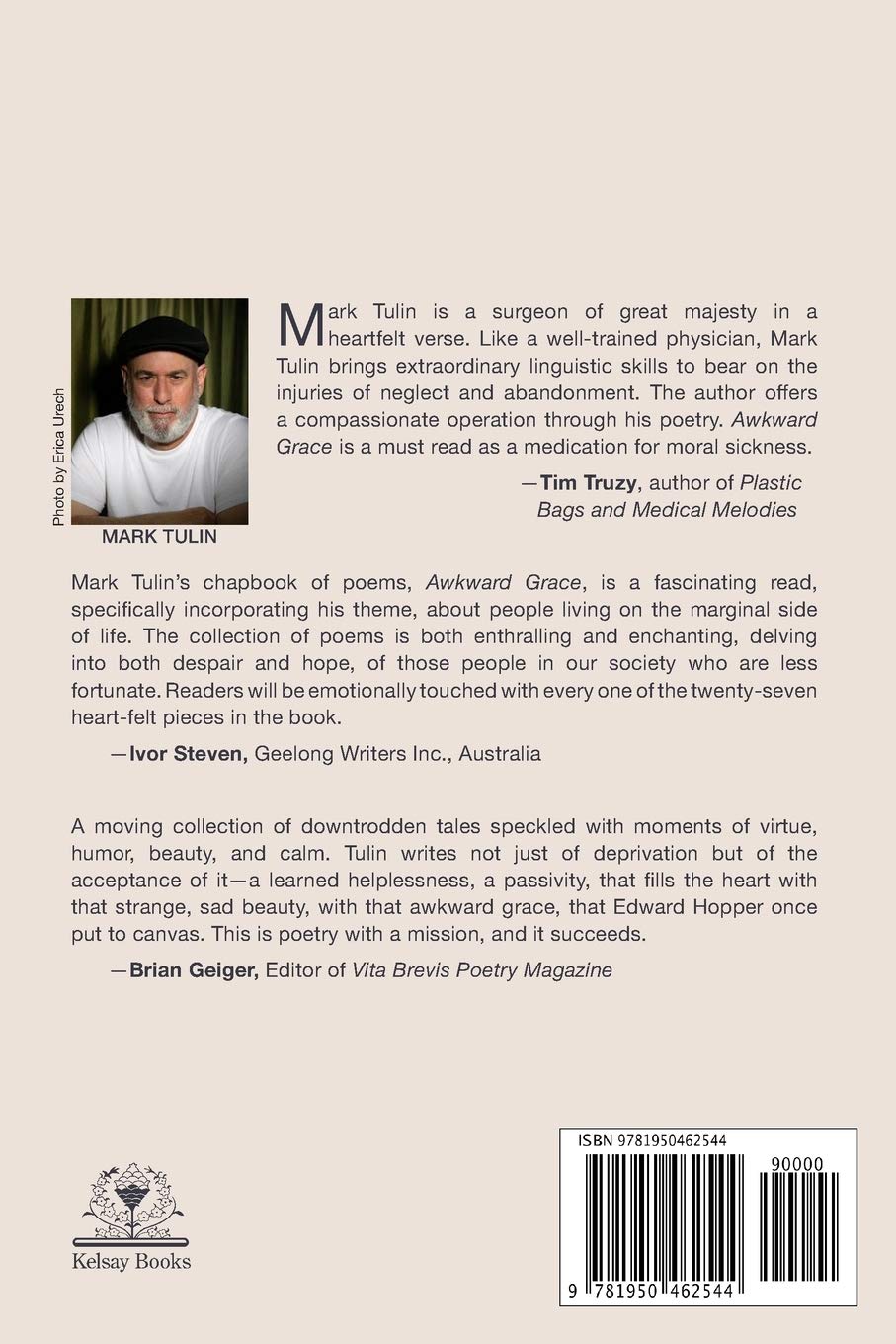
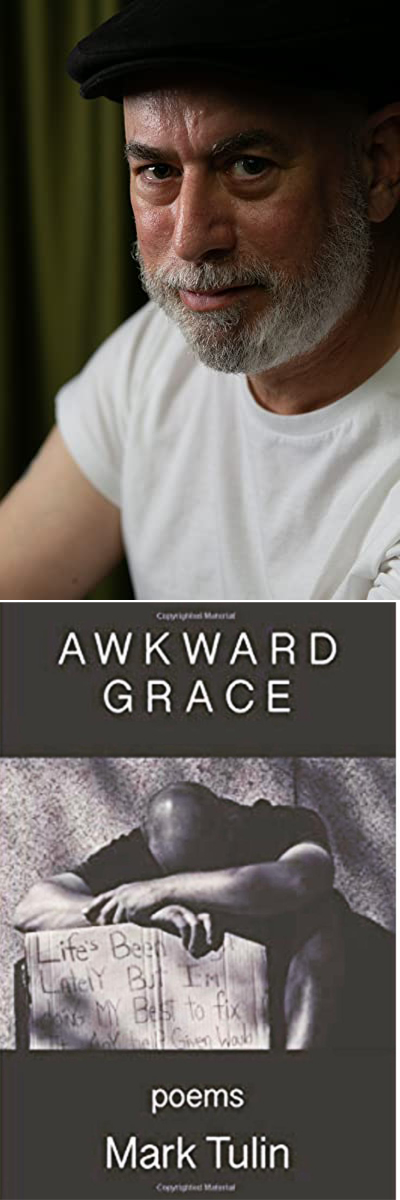
Has this poem been published before? And if so, where? Ancient Pyramid was first published in my poetry chapbook, Awkward Grace (Kelsay Books, 2019). Copies may be purchased on Amazon, Barnes and Noble, or at Kelsay Books.
Yes, the poem was published in my second book of poetry, Awkward Grace. Awkward Grace’s theme is about homelessness and the different aspects of being homeless, from dumpster diving to dealing with people’s reactions on the street and in public places.
Ancient Pyramid, by Mark Tulin
Stanley has just enough strength to pick up the potatoes.
He dumps one burlap bag after another into a large bin,
each Idaho having a different character, a different shape.
The machine churns and catches a potato or two.
They fall onto a rattling conveyor belt
in the quiet darkness of the warehouse floor.
Stanley takes three swigs from the whiskey bottle.
One for his father, another for his mother
and the last swig for a future that might never come.
The potatoes slowly move to their destination,
dropping into five-pound plastic bags,
weighed on a chain-linked scale,
tied and stacked onto a pallet like an ancient pyramid.
After years of bagging potatoes and drinking whiskey,
Stanley’s life comes to a grinding halt
as the motor of the bagging machine conks out.
He drops like a sack to the dirty warehouse floor,
squarely on top of the wooden pallet.
He swells up like a rough, knotty potato
and lays there like a bagged Idaho.
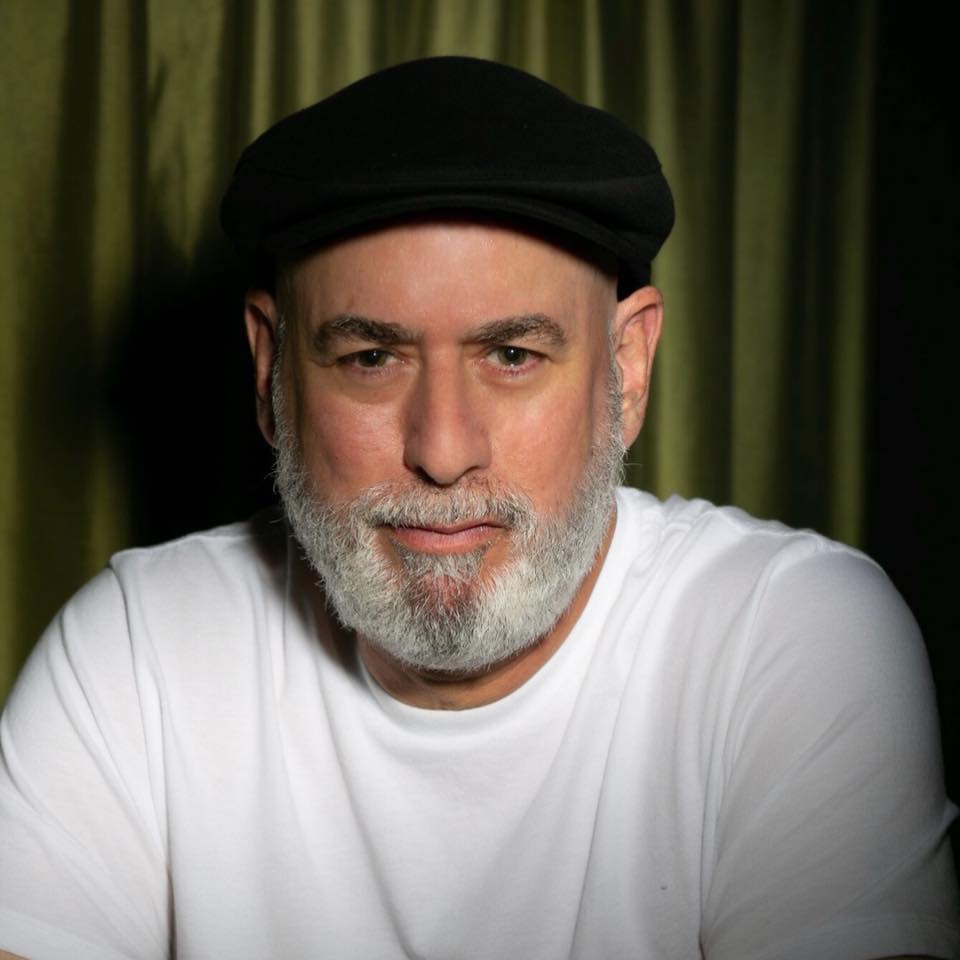
Mark Tulin is a former mental health therapist who lives in Santa Barbara, California. Mark has two poetry books, Magical Yogis and Awkward Grace, available on Amazon. He has an upcoming book of fiction, The Asthmatic Kid and Other Stories available in August. Mark has been featured in Fiction on the Web, Wild Literary Magazine, Terror House Magazine, Trembling with Fear, Visitant, Oddball Magazine, New Readers Magazine, as well as anthologies, college journals, and podcasts.
 Crow On The Wire
I like Stanley and the way you cared about him, seeing the person underneath his outward appearance.
Thanks. He was a beautiful person.
I think as kids we could always see the real person. I’m so happy he had you to tell his story.
Thanks.
It’s interesting to learn the backstory of a poem. In the case of “Ancient Pyramid,” we gain a greater appreciation for the person who has inspired the poem. We see what some may regard as “a loser” in society in a new light, thereby creating new opportunities for dealing with those individuals who have lost their footing in life. I look forward to reading the entire collection. My copy is on its way.
Well said.
As I read the back story interview, I kept thinking, I want to read this poem, I want to read this poem. That part of it was very nicely done! The poem definitely lived up to its promise. Stanely’s memory will live on.
Thanks Liz
You’re welcome, Mark.
Amazing! Thank you for sharing, Mark.
Thanks, Theresa.
People don’t realize the artistry of a person’s job. 🖌 I wonder how many jobs that people didn’t realize over the years were actual an art 🎨 – the artistry of jobs from 1900’s until 2020 has been lost over the years. Is there a person today (I’m dreaming of course) that could do Stanley’s job designing an “ancient pyramid” out of 5 lb and🥔 10 lb bags 🥔of potatoes? 🥔
Mark you have made ⭐Stanley⭐a “star” that has luminous pyramid above it.
Wait a minute – doesn’t the top of the star kind of looks like a pyramid????
Thank you again!! Hope
Yes, there are so many jobs and heroes working at them who are worthy of our attention.